
5 Steps to Cleanse Your Mind and Overcome Stress in a Sedentary World
Introduction
The world is becoming sedentary as we speak. Recently, the World Health Organization (WHO) released a report that showed a negative trend. 1.8 billion people in the world are not meeting the recommended standards of physical activity. Growing digitization and remote studying/work options have all contributed to this growing trend in a post-COVID world. Yet, a sedentary lifestyle is not necessarily accompanied by rest, relaxation, or peace. Stress levels are ever-increasing!
So, what can you do to reduce stress in this sedentary world? In this article, we shall look into five great options you can engage in to cleanse your mind and overcome stress.

How stress affects your health
Stress is a strain on your mind and body as a consequence of an event that gives rise to the same; this event is known as a stressor. It keeps your mind and body in an alert state as they go into a fight-or-flight mode. Prolonged stress eventually leads to exhaustion.
Prolonged stress not only leads to physical exhaustion but also affects mental health. Effective cures for mental health disorders often involve therapy, stress management techniques, and lifestyle changes to restore balance and well-being.
Chronic stress affects the mind and body in several ways. It can lead to:
Anxiety
Anger
Feeling overwhelmed
Lowered focus and motivation.
Substance use
Sleep difficulties
Memory difficulties
Lowered sex drive
Headache, chest pain, and other bodily aches.
Tiredness
Weakened immune system.
5 Steps to Cleanse Your Mind and Overcome Stress
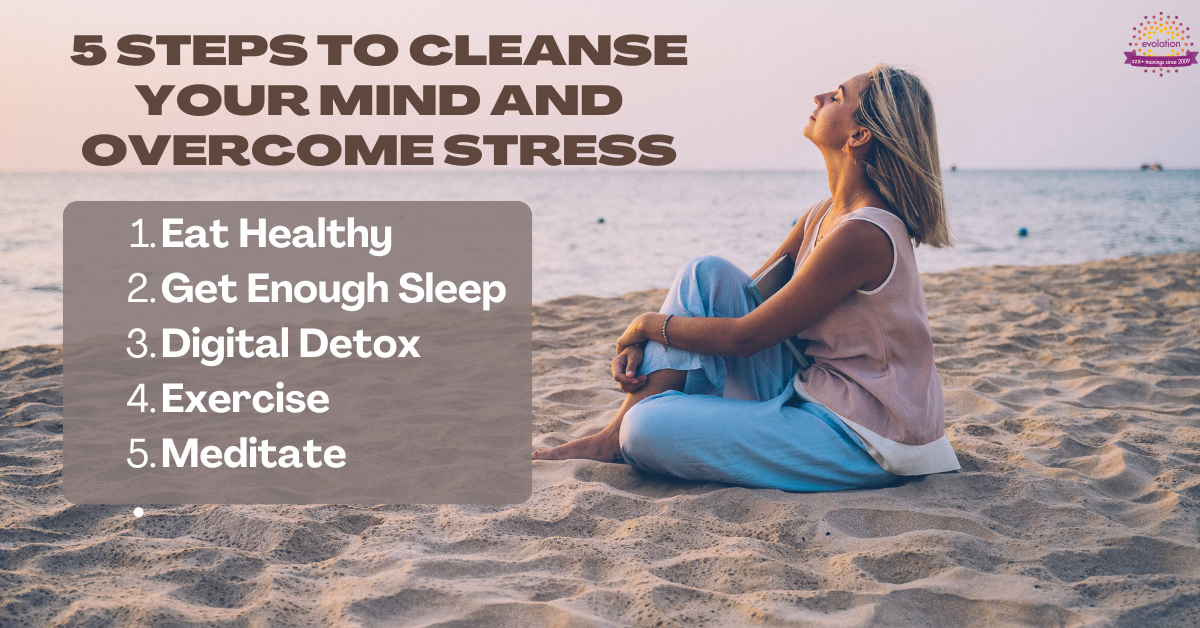
Eat Healthy
Eating healthy is an important way of overcoming stress. This includes a balanced diet of fruits and vegetables, proteins, carbohydrates, minerals, and vitamins. At the same time, avoiding unhealthy food, like junk food, is also crucial.
Foods containing omega-3s and vitamin E act as stress-relieving food items.
Moreover, if you want to cleanse your mind, you can engage in mindful eating. Yes, mindfulness is a practice you can incorporate even while eating. You can do this by:
Putting away all digital devices and other distractions.
Eat your meal in silence for the first few minutes.
You can try to eat with your non-dominant hand, as this helps increase your focus.
Pay explicit attention to what you are eating. Take in the aroma, savor the flavor, and enjoy the feel of the food on your tongue.
By engaging in mindful and healthy eating, you can stay connected to the present and focus on the food at hand. This will clear your mind and facilitate optimal health.
Get Enough Sleep
A good night's sleep of seven to nine hours is essential for health. It also allows your body to rest and reduces stress. It keeps your mind fresh and gets you rejuvenated for the next day. On the other hand, sleep difficulties keep you feeling tired and drained. This only adds to your burdens.
Therefore, establish a time for sleep. Maintain a routine. Engage in a digital detox hour before going to sleep. Create a good sleep environment. This will help your body prepare for sleep better. If sleeplessness is something that is bothering you, then engage in deep breathing exercises before sleep. This relaxes your body and paves the way for a good sleep.
Digital Detox
Digital devices are perhaps one of the most prominent factors that give rise to stress in the digital world. They connect you to your studies, work, and social life. To give you a simple example, if you are on something like Instagram, constant social comparisons and consequent feelings of inadequacy lead to a significant amount of stress. Similarly, study and work-related updates can also give rise to stress.
Therefore, a digital detox is one of the first steps you can take to overcome stress. Keep away all the digital devices for one hour during the day. Call this your "digital detox hour." You can use this time to engage in something healthy, like deep breathing, meditation, yoga, or other practices that can help you cope with stress. You can also use this time to bond properly with your family or other social connections.
Exercise
Exercise is a great way to reduce stress. It also gets you out of the sedentary lifestyle if you happen to lead one and keeps your body active and healthy. The great thing is that exercise distracts you, allows you to relax, and reduces stress.
With exercise, you do not have to hit the gym hard straight away. As is the case with meditation, begin small. Start by setting aside 15 minutes per day. Over time, this will become a routine and will not seem like too much effort anymore.
You can try any physical exercise you see fit, like walking, jogging, running, swimming, or going to the gym. You can also incorporate mindfulness into exercise to clear your mind further. You can do this by focusing on:
The feel of the ground beneath your feet (or even your palms, if it applies).
How does your body feel, and how does it react to your movements?
By practicing mindfulness during exercise, like mindful walking, you can stay connected with your present and not let your mind veer away to somewhere else.
Meditate
Meditation is a good way to increase focus and relax. It is also a healthy way to reduce negative emotions like stress. Meditation involves noticing your thoughts without judgment, letting them go, and bringing your focus back to the present. You can use your breath as an anchor while meditating.
To begin with,
Start small. Set aside five to ten minutes per day and find a quiet, comfortable place where you can sit and meditate.
Focus on your breath. Count your breaths as you inhale and exhale, as one and two. If you find your mind wandering, do not become frustrated. Start over again.
The mind may wander at times, and many thoughts may come to your mind. Note them and let them go. Use your breath to bring your focus back to the present.
If you find your mind wandering a bit too much, take a break. Then, start afresh.
Final Reflections
Sedentary lifestyles have become common. Unfortunately, they are not healthy and only exacerbate stress. Therefore, engaging in healthy practices like eating healthily, getting a good night's sleep, exercising, meditating, and digital detoxing are the five most basic practices you can engage in to cleanse your mind and overcome stress. Moreover, they also create a healthy lifestyle.
While these practices may not be easy to incorporate right from the get-go, the trick is to take baby steps. With time and effort, they will become ingrained and feel like second skin.
