Why Hot Yoga Teachers Add Yin
If you teach hot yoga, your body lives in the yang end of the practice: 90 minutes, 26 postures, a room near 105°F, and sweat for every class you lead or take. Yin yoga is the opposite end, and that is exactly why so many hot yoga teachers end up training in it.
This isn't about switching styles. Paul Grilley, one of the teachers who built modern yin yoga, taught Bikram Yoga before he developed yin, and he and Sarah Powers designed it as a complement to active practice, not a replacement (Wikipedia). Here is what yin adds for a hot yoga teacher: for your own body, your students, your teaching and your schedule.
Hot yoga and yin yoga: opposites by design
Yin yoga is a slow practice of passive floor postures held for about 3 to 5 minutes each. The muscles stay soft, so the load reaches the deeper connective tissue: ligaments, fascia and the joints (Evolation). The hot series asks for the reverse: active, muscular effort in a heated room.
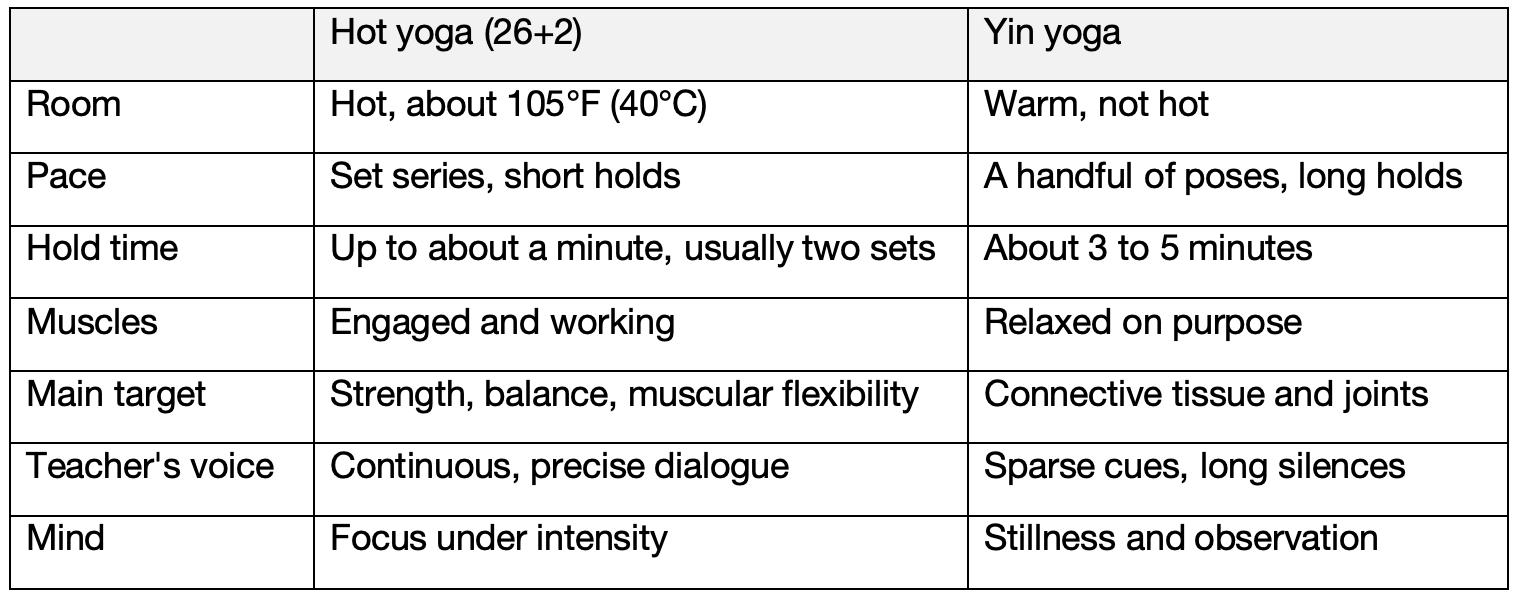
Five reasons hot yoga teachers add yin
1. It balances your own practice
Most hot yoga teachers practice the same series several times a week while teaching even more. Yin gives the body a different kind of load: long, quiet, low-effort holds in the hips, pelvis and lower spine, the areas yin sequences focus on most (Wikipedia). It is also rest for a nervous system that spends most of its week in the heat.
2. Your students need it too
Many hot yoga students are type-A, driven and used to pushing. A slow class can feel like the hardest thing they do all week, and that is the point. When you can offer both, students who would never take a quiet class from a stranger will try it with the teacher they already trust.
3. It makes you a better hot yoga teacher
The hot series is taught with a near-constant spoken dialogue. Yin forces the opposite skill: fewer words, longer pauses, and watching bodies rather than talking at them. Teachers who learn to hold silence in a yin room usually bring a calmer, clearer voice back to the hot room.
4. It widens what you can teach
A yin certification lets you fill slots a hot yoga schedule leaves empty: late evenings, Sunday wind-downs, recovery classes, and workshops paired with a hot class. Studios that run both styles look for teachers who can cover both.
5. It helps you keep practicing for decades
The heat is demanding, and most long-term teachers eventually adapt how they practice. Yin is a practice you can sustain at any age and intensity, which matters if you plan to teach for the next 20 years, not just the next two.
Should yin be taught in a hot room?
Warm, yes; hot, with care. Because students barely move in yin, they cool down, so the room is often kept a little warmer than a normal studio (Wikipedia). Full hot-yoga heat is a different matter.
Yin teacher and author Bernie Clark points out that yin is usually practiced with cool muscles, so the stress of a pose can reach the connective tissue. In "hot yin" classes, often run around 95°F (35°C) rather than 105°F (40°C), he notes that the warm muscles take more of the load (yinyoga.com). He doesn't dismiss it, though: he asks why so many studios and students love their hot yin classes anyway.
The practical takeaway for a hot studio: turn the heat down for yin, tell students why, and teach them not to chase depth just because the room makes them feel bendy.
How hot yoga teachers blend the two
You don't need a new studio to use yin. These are the formats hot teachers most often add:
• A standalone yin class in a cooled room, on a slow night of the week or the weekend.
• A short yin finish after a hot class: two or three long floor holds before savasana, once the heat is off.
• Yin and hot workshops: a hot class, a break, then a yin session on hips or spine, sold as one event.
• Recovery classes for regular hot students, framed as the other half of their practice rather than "easy yoga".
• Your own weekly yin practice, even if you never teach it, to balance your teaching load.
Whatever the format, keep the rules of each style clear. Hot classes keep their set series; yin classes keep their long, passive holds and their quiet.
What a yin certification adds, and how Evolation teaches it
Taking a yin class is not the same as knowing how to teach one. A good yin training teaches how long to hold each pose, how to use props so the muscles can let go, how bone structure changes what a pose looks like on different bodies, and how to sequence a class that feels unhurried without being empty.
Evolation's Yin Yoga Teacher Training is an 84-hour course from a Yoga Alliance Continuing Education Provider (YACEP), so it counts as continuing education for teachers who are already registered. You can take it as a 7-day in-person immersion, online at your own pace, or as a mix of the two. The curriculum covers:
• Yin history and principles, from Taoist yoga to modern yin
• Anatomy for yin: major joints, tendons, ligaments, fascia, and how bone structure shapes each posture
• Meridian theory and how to use it in class
• The art of teaching yin: voice, pacing, props, music and sequencing
• Meditation and breathing techniques for yin classes
• The business of teaching yoga
Before graduating, every trainee teaches at least one full class. As with all Evolation trainings, graduates can come back to the same training again, anywhere in the world, for free.
The teachers know both rooms. Tavira lead trainer Juliette Snijders trained in hot yoga and vinyasa with Evolation and certified in yin with Bernie Clark's program in Vancouver. Karen Denis teaches the 26+2, yin and vinyasa (Tavira program).
Frequently asked questions
Do I need to be a certified teacher to take yin yoga teacher training?
No. Evolation's yin training is open to all levels, from newer practitioners to experienced teachers. If you are already a Registered Yoga Teacher, the hours also count as continuing education with Yoga Alliance.
Can I teach yin in a hot yoga studio?
Yes, and many hot studios already run yin. Lower the heat to warm rather than hot, so the stress of each pose reaches the connective tissue rather than being taken up by warm muscles.
Is yin the same as restorative yoga?
No. Both use long holds, but restorative yoga uses props to support the body completely, aiming for deep rest with little or no stretch. Yin deliberately places a gentle, sustained load on the tissues around the joints.
How long are yin poses held?
Usually 3 to 5 minutes, and sometimes longer for experienced students.
Can I do the yin training online?
Yes. You can study the whole program online at your own pace with on-demand videos and one-to-one sessions, or start in person and finish online.
How much does it cost?
Currently $1,400 in person ($1,200 if paid in full at least 60 days before the start) or $700 online. Check the yin pricing page for current rates and payment plans.
Add the other half of the practice
You already know how to teach intensity. Yin teaches you to teach stillness, and your students, your schedule and your own body will feel the difference.
Explore the 84-hour Yin Yoga Teacher Training, study it online at your own pace, or see upcoming in-person dates. Not certified in hot yoga yet? Start with our Hot Yoga Teacher Training.
Questions? Call +1 (561) 827-8279 or email train@evolationyoga.com.
