
The Remarkable Journey of Joseph Pilates: How Ancient Wisdom Inspired a Modern Movement Revolution
From Sickly Child to Fitness Pioneer
Joseph Hubertus Pilates was born on December 9, 1883, in Mönchengladbach, Germany, into a family that would profoundly shape his destiny. His father, Heinrich Friedrich Pilates, was a prize-winning gymnast and locksmith, while his mother embraced naturopathic healing principles—believing firmly in the body's innate ability to heal itself.
Young Joseph's childhood was far from the picture of health that would later define his legacy. He suffered from rickets, asthma, and rheumatic fever, conditions that left him physically weak and vulnerable. Adding insult to injury, bullies tormented him relentlessly, even taunting him with cruel references to "Pontius Pilate, killer of Christ" due to his surname. At age five, one particularly brutal episode resulted in the loss of sight in his left eye.
Rather than succumbing to his afflictions, these hardships ignited a fierce determination within Joseph. He embarked on what would become a lifelong obsession with physical fitness and the healing power of movement. His father introduced him to gymnastics exercises at the Turnverein, the German gymnastics club, and by age nine, Joseph was already developing his own exercise routines.
The Fusion of East and West: Yoga's Profound Influence
What set Joseph Pilates apart from other physical culturists of his era was his intellectual curiosity and willingness to draw from diverse traditions. He studied both Eastern disciplines including yoga, tai chi, kung fu, and qigong, as well as Western disciplines of body-building, boxing, gymnastics and recreational sports. This synthesis of Eastern and Western philosophies would become the cornerstone of his revolutionary method.
By his twenties, Joseph Pilates had studied and drew inspirations from Eastern practices and Zen Buddhism, incorporating their emphasis on mindfulness, breath control, and the mind-body connection. The influence of yoga on his developing methodology was particularly significant. Like yoga, Pilates emphasized:
Breath as Foundation: Both disciplines recognize breathing as fundamental to movement and mental clarity. While yoga traditionally employs deep diaphragmatic breathing, Pilates would later adapt this to lateral thoracic breathing—expanding the ribcage sideways while maintaining core engagement—but the underlying principle of conscious breath control came directly from Eastern practices.
Mind-Body Unity: Zen Buddhism and other Eastern practices taught him the importance of mindfulness and the connection between the body and mind, with this focus on deliberate breathing and concentration becoming central to the Pilates method. This philosophical framework distinguished his work from mere calisthenics.
Flowing Movement: The concept of continuous, controlled movement found in yoga and tai chi informed Pilates' approach to exercise sequencing, where one movement flows seamlessly into the next.
Core Awareness: While the specific focus on what Pilates called the "powerhouse" was his innovation, the Eastern emphasis on the body's center—what yoga and martial arts traditions refer to as the dan tian or hara—provided philosophical grounding.
Joseph believed that optimal health required harmony between the body, mind, and spirit, a principle that remains foundational to Pilates today. He also became fascinated by the ancient Greek ideal of the perfect human—balanced in body, mind, and spirit—a concept that bridged Eastern and Western philosophical traditions.
Interestingly, Joseph would spend hours lying in the woods observing animal movements, particularly studying how mother animals taught their young to move. This naturalistic observation complemented his formal studies and later informed many of his exercises, particularly his insights into intuitive, efficient movement patterns.
By age 14, Joseph had transformed his body so dramatically that he posed for anatomical charts—a testament to his dedication and the effectiveness of his self-designed training regimen.
The War Years: Where Innovation Was Born from Necessity
In 1912, seeking broader opportunities, Joseph moved to England where he worked as a professional boxer, circus performer, and self-defense instructor, even training detectives at Scotland Yard. His life took a dramatic turn when World War I erupted in 1914.
The British authorities interned Pilates, along with other German citizens, in Lancaster Castle, and later transferred him to Knockaloe camp on the Isle of Man, where over 24,000 German nationals were detained. These years of involuntary confinement became the crucible in which his method was forged.
Rather than succumbing to the depression and despair that claimed many internees, Joseph organized exercise classes for his fellow prisoners. It was there that he began refining and teaching his minimal-equipment system of mat exercises that later became "Contrology"—his term for what we now call Pilates. The name reflected his core philosophy: the mind controlling the muscles, not vice versa.
The Birth of Revolutionary Equipment
The internment camp experience led to Joseph's most ingenious innovations. Many prisoners fell ill, and during the catastrophic 1918 influenza pandemic that killed millions worldwide, Joseph was tasked with helping bedridden patients maintain their health.
In those days bed rest was considered the best treatment for most illness, and Pilates was told he could do anything with the patients as long as they stayed in bed. His solution was revolutionary: he created an apparatus from bunk beds and springs to allow bed-ridden inmates an effective way to exercise.
By attaching springs from hospital bed frames to patients' limbs, Joseph enabled them to perform resistance exercises while lying down. This ingenious system allowed weakened individuals to work against resistance without bearing their full body weight—a breakthrough in rehabilitation. His care and fitness regimen is widely credited for the fact that no one in his camp contracted influenza during the great 1918 flu epidemic.
These wartime innovations became the foundation for what would later be known as the Cadillac (or Trapeze Table)—the largest and perhaps most versatile piece of Pilates apparatus. The Reformer, another cornerstone of Pilates training, also evolved from these early experiments with springs and resistance.
The American Dream: Building an Empire of Movement
After the war, Joseph returned to Germany where he trained the Hamburg Military Police and collaborated with renowned movement theorist Rudolf von Laban, who incorporated some of Joseph's theories into his own work. However, Joseph grew increasingly uncomfortable with Germany's political climate.
Around 1925, Pilates immigrated to the United States, sailing toward what he hoped would be greater opportunity. During the voyage, fate intervened in the form of Clara Zeuner, a nurse suffering from arthritis. On the ship to America, he met his future wife Clara, and their connection was immediate and profound.
The New York Studio: Where Dancers Discovered Contrology
The couple founded a studio in New York City at 939 Eighth Avenue and directly taught and supervised their students well into the 1960s. The location was strategic—sharing an address with the New York City Ballet, the studio quickly attracted the attention of the dance community.
Joseph and Clara Pilates soon established a following in the local dance and performing-arts community of New York. Luminaries of the dance world recognized something special in Joseph's work. George Balanchine, who had arrived in the United States in 1933, and Martha Graham became devotees, sending their students to the Pilates for training and rehabilitation.
The studio itself was a unique space. Large picture windows overlooked Eighth Avenue, decorated with lace curtains and adorned with plants and flowers. The walls displayed paintings, anatomy charts, before-and-after photographs of clients, exercise charts, letters of endorsement, and large mirrors. A bronze bust of Joseph, sculpted by a grateful client, presided over one corner.
Joseph and Clara maintained a highly personalized approach to instruction. There were no group classes on the apparatus—each student received individual attention and a customized workout designed for their specific needs. Joseph himself had a direct, sometimes gruff manner, but his genuine care for his clients shone through. He would famously end sessions by announcing, "One hour! Hit ze shower!"
The Philosophy Behind the Method: Contrology as a Way of Life
The guiding philosophy in his work, which he referred to as "Contrology," was the notion that exercising the entire body in concert, as opposed to spot training individual muscles, was the way to achieve good health.
Joseph's philosophy extended far beyond physical exercise. He envisioned Contrology as nothing less than a paradigm for living. His vision was that a systematic, disciplined approach to physical and mental mastery would raise the individual to a place of higher personal awareness, and would positively impact the world by eliminating human suffering and reducing the need for hospitals, sanitariums, mental institutions, and even prisons.
This ambitious vision reflected his belief that many of society's ills stemmed from poor physical health, which in turn affected mental and emotional well-being. He argued that modern lifestyles, characterized by poor posture, shallow breathing, and lack of exercise, were the root causes of disease and suffering.
The Six Core Principles
Joseph's method rested on fundamental principles that distinguished it from other exercise systems:
Centering: All movement originates from the core—what Joseph called the "powerhouse," encompassing the abdomen, lower back, hips, and glutes. This concept drew from both Western anatomical understanding and Eastern philosophies about the body's energetic center.
Concentration: The mind must fully engage with each movement. This principle directly reflected his studies in Zen Buddhism and yoga, where mindfulness is paramount.
Control: Muscles should be controlled by conscious thought, not by momentum or unconscious habit. Hence the original name "Contrology."
Precision: Each movement has a specific form and purpose. Quality of movement matters far more than quantity.
Breath: Joseph's classes always began with deep breathing, a primary component of his method. He asked only two things of students: "Learn the exercises and learn to breathe!"
Flow: Movements should transition smoothly, with grace and efficiency, reflecting the influence of Eastern movement practices.
The Revolutionary Apparatus: Engineering Innovation
Joseph Pilates was a prolific inventor, with over 26 patents cited. His mechanical genius resulted in a complete system of specialized apparatus, each designed to challenge the body in unique ways while providing support and resistance.
The Reformer
The Reformer remains the most iconic Pilates apparatus. This elegant machine features a sliding carriage mounted on a frame, with springs providing adjustable resistance. The practitioner lies, sits, stands, or kneels on the carriage, pushing or pulling against the springs while maintaining proper alignment. The Reformer's versatility made it the cornerstone of Pilates training.
The Cadillac (Trapeze Table)
Named for the American automobile brand that represented "the best of everything" during the 1950s and 60s, the Cadillac is the largest of the Pilates apparatuses. Born from Joseph's wartime innovations with hospital beds, the Cadillac features a raised platform with an overhead frame from which hang springs, bars, and straps.
According to Romana Kryzanowska, one of Joseph's most important students, the name "Cadillac" was actually given by a client in the 1940s who compared the luxurious comfort and sophisticated engineering of the apparatus to the famous automobile. The Cadillac's height made it particularly suitable for older clients or those recovering from injuries who had difficulty getting down on the floor.
The Wunda Chair
The Chair apparatus demonstrated Joseph's creativity in designing equipment that was both functional and space-efficient. Patented in 1934, it could function as an actual chair while also serving as a sophisticated exercise device. The Chair featured spring-loaded pedals and back support, allowing for challenging resistance training in a compact form.
The Barrels and Other Innovations
Joseph created various barrel-shaped apparatus to support spinal extension and flexion. Legend has it that his inspiration came from the beer barrels delivered to his studio—Joseph reputedly loved beer and experimented with the wooden barrels and metal rings, eventually developing them into therapeutic equipment.
His other inventions included the Magic Circle (a flexible metal ring for resistance training), the Tensometer (a device measuring applied force), and numerous smaller props and accessories. He even designed futuristic furniture intended to promote better posture and healthier living.
The Written Legacy
Joseph committed his philosophy to writing in two important books:
"Your Health: A Corrective System of Exercising That Revolutionizes the Entire Field of Physical Education" (1934): This early work laid out his critique of modern lifestyles and his vision for societal transformation through physical fitness.
"Return to Life Through Contrology" (1945): This book, co-authored with William J. Miller, remains the definitive guide to Joseph's method. It outlines the philosophy and technique behind Contrology, presenting it as an approach to whole-body health that was, in Joseph's words, "designed to give you suppleness, natural grace, and skill that will be unmistakably reflected in the way you walk, in the way you play, and in the way you work."
In "Return to Life," Joseph famously wrote: "Physical fitness is the first requisite of happiness." He continued: "Contrology develops the body uniformly, corrects wrong postures, restores physical vitality, invigorates the mind, and elevates the spirit."
The First Generation: Preserving the Legacy
A number of dancers became "first generation" Pilates teachers, including Carola Trier, Eve Gentry, Ron Fletcher, Kathleen Stanford Grant, Bruce King, and Lolita San Miguel. These dedicated students would become the "Elders" of Pilates, preserving Joseph's teachings and passing them to subsequent generations.
Clara proved instrumental in the studio's success. According to Mary Bowen, who trained under both Joseph and Clara, it was Clara's business-sense that kept the studio running, and "she was the better teacher". Clara possessed a gentler teaching style than her husband and often worked with clients who found Joseph's intensity overwhelming.
The studio operated on a unique model—no memberships, pay-as-you-go, and every session was private instruction on the apparatus or semi-private mat classes. This personalized approach ensured that students learned the exercises correctly and received modifications suited to their individual needs.
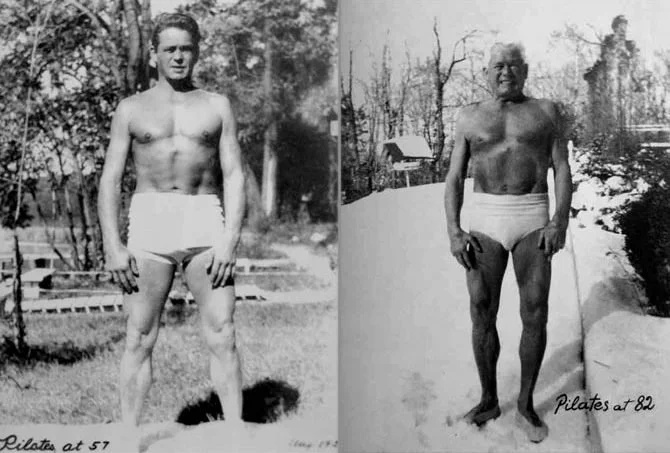
Joseph continued teaching well into his eighties. His impressive physique is evident in a famous series of photographs taken by photojournalist I.C. "Chuck" Rapoport, who visited Pilates' New York studio in 1961 for Sports Illustrated. These images, taken when Joseph was 78 years old, show a remarkably fit man demonstrating his exercises with precision and power.
Pilates died in New York City in 1967 of advanced emphysema at the age of 83. According to some accounts, his death resulted from complications after slipping on ice and puncturing his lung. Clara continued teaching and running the studio until her retirement in 1970 at the remarkable age of 90.
The Modern Evolution: From Underground Secret to Global Phenomenon
After Joseph's death, his method faced an uncertain future. He had left no will and designated no clear line of succession. However, the Elders—those first-generation students who had trained directly with Joseph and Clara—became guardians of his legacy.
Romana Kryzanowska, who had studied with Joseph since the 1940s, took over directorship of the New York studio in 1975, moving it to 56th Street and preserving the classical method in its purest form. Other Elders spread Pilates across the country and around the world: Jerome Andrews to Paris, Eve Gentry to Santa Fe, Ron Fletcher to California.
The Trademark Battle
In the 1990s, a legal battle erupted that would define Pilates' future. One practitioner had registered "Pilates" as a trademark and began sending cease-and-desist letters to other instructors and equipment manufacturers, claiming exclusive rights to the name.
A four-year legal battle ensued, with many in the Pilates community, including John Steel (Joseph's former client and business associate), fighting to establish that "Pilates" was a generic term—like "yoga"—that belonged to everyone, not a proprietary brand. In 2000, a federal court agreed, ruling that "Pilates" had become a generic term for the exercise method and could not be monopolized by a single entity.
Contemporary Explosion
Today, Pilates has evolved into a global movement. Statistics show the number of Americans practicing Pilates regularly exploded from 1.7 million in 1991 to over 11 million by 2005, and growth has continued since then. The method has expanded far beyond the dance community to athletes, rehabilitation patients, pregnant women, seniors, and fitness enthusiasts of all types.
Professional athletes in the NFL, NBA, MLB, and Olympic sports incorporate Pilates training for injury prevention, performance enhancement, and recovery. Physical therapists integrate Pilates principles into rehabilitation protocols. Boutique studios offering group Reformer classes have proliferated, though purists note that Joseph himself never taught group apparatus classes—only private or semi-private sessions.
Classical vs. Contemporary
The Pilates world has divided into two main camps:
Classical (or Authentic) Pilates: Practitioners like Romana Kryzanowska and organizations like Power Pilates strive to preserve Joseph's original teachings, exercise sequences, and apparatus specifications. They maintain that Joseph's genius lay in the complete, integrated system he created, and modifications risk diluting its effectiveness.
Contemporary Pilates: Other practitioners have adapted and evolved the method, incorporating insights from modern biomechanics, physical therapy research, and other movement disciplines. They argue that Pilates, like any system, should evolve with new knowledge and understanding of the human body.
Both approaches honor Joseph's legacy in different ways, and the debate continues in the Pilates community today.
The Enduring Influence of Eastern Philosophy
Looking back at Joseph Pilates' remarkable journey, the profound influence of Eastern practices—particularly yoga—on his revolutionary method becomes clear. While Pilates and yoga have evolved into distinct disciplines with different emphases, they share deep philosophical roots:
Mind-Body Integration: Both recognize that physical practice affects mental and emotional states, and vice versa. This holistic view, so common in Eastern traditions, was revolutionary in Western fitness when Joseph introduced it.
Breath as Bridge: Both systems use conscious breathing to connect mind and body, though they employ different techniques. Yoga's emphasis on pranayama (breath control) directly influenced Joseph's decision to make breathing fundamental to his method.
Mindful Movement: The quality of attention brought to each movement matters as much as the physical action itself. This principle, central to yoga and meditation practices, distinguishes Pilates from mere exercise.
Functional Integration: Like yoga's asanas, Pilates exercises integrate multiple muscle groups and movement patterns simultaneously, training the body as a unified system rather than isolated parts.
Therapeutic Application: Both traditions recognize exercise as medicine—not just for building strength or flexibility, but for healing injury, managing chronic conditions, and promoting overall well-being.
The key differences lie in their specific techniques and emphases: yoga typically involves static poses held for extended periods and places greater emphasis on spiritual development, while Pilates features dynamic, flowing movements focused on core strength and precise physical rehabilitation. Yoga's breathing tends toward deep diaphragmatic patterns, while Pilates employs lateral thoracic breathing to maintain core engagement during movement.
Conclusion: A Century of Transformation
Nearly a century after Joseph Pilates immigrated to America with his innovative method, his vision of whole-body health through intelligent, controlled movement has transformed millions of lives. The sickly child who taught himself to thrive through studying yoga, watching animals, and synthesizing Eastern and Western wisdom created something genuinely revolutionary.
What makes Joseph's legacy so powerful is not just the exercises or equipment he invented, but the underlying philosophy that movement, practiced with awareness and precision, can heal, strengthen, and transform not just bodies but entire lives. His integration of yoga's mindfulness principles with Western anatomical understanding and mechanical innovation produced a system that remains remarkably relevant in our modern age.
As Joseph wrote: "Contrology is complete coordination of body, mind, and spirit. Through Contrology you first purposefully acquire complete control of your own body and then through proper repetition of its exercises you gradually and progressively acquire that natural rhythm and coordination associated with all your subconscious activities."
Today, whether practiced in its classical form or contemporary adaptations, whether on a mat or elaborate apparatus, Pilates continues to embody Joseph's vision: that by bringing conscious awareness to movement, by honoring the wisdom of both East and West, and by treating the body as an integrated whole, we can achieve not just physical fitness, but true vitality—harmony of body, mind, and spirit.
The method that began with a sickly German boy studying yoga in the woods, refined in wartime internment camps with improvised equipment, and perfected in a New York studio, has become a global movement that continues to evolve while honoring its roots. Joseph Pilates' genius lay not just in what he created, but in how he synthesized ancient Eastern wisdom with Western innovation to address the needs of modern life—a synthesis that remains as relevant today as it was a century ago.
