
3 Types of Emotional Intelligence Explained And How to Improve Each of Them
Emotional intelligence (EQ) isn't just a skill. It's a multilayered term that researchers have explored through three distinct scientific models: Trait, Ability, and Mixed. Each model describes the same general set of emotional and social skills but interprets, measures, and applies them in different ways.
Understanding the types of emotional intelligence will show that one framework emphasizes personality traits, while another focuses on measurable abilities. It also gives you a clearer picture of how to improve emotional self-regulation, especially if you've noticed low EQ symptoms.

Emotional Intelligence Explained
Emotional intelligence (EQ) is the ability to recognize, understand, and manage your own emotions, as well as respond effectively to the feelings of others. While early research was influenced by social intelligence theories from the mid-20th century, modern EQ has grown into a field that blends psychology, neuroscience, and behavioral science.
Despite its popularity, emotional intelligence still has areas that require more research, especially regarding its long-term impact on career advancement, leadership effectiveness, and cross-cultural communication. A study by Feist and Barron suggests high EI can be a better predictor of professional success than IQ, while others call for more robust evidence and standardized measurement tools.
Trait Model of Emotional Intelligence
The Trait Model is a type of emotional intelligence based on the work of psychologist Konstantinos V. Petrides, who proposed that EQ is best understood as part of our personality. Rather than being a pure skill set that can be measured in a test of problem-solving or memory, this model views EQ as a set of emotional self-perceptions. Shortly put, if you believe you can manage your emotions and interact socially, you will be able to do so.
Petrides argued that measuring EQ would be challenging because it would mean measuring personality. However, measuring self-perceptions would mean measuring a Trait type of emotional intelligence. This EQ test online follows self-report questions from popular theories like Goldman's theory and the Trait Emotional Intelligence Questionnaire (TEIQue) rather than performance-based tasks.
Key components of Trait type of emotional intelligence:
Emotional self-perception. How well do you believe you understand your own emotions?
Well-being. This component measures your level of life satisfaction and whether you tend to view life through an optimistic or pessimistic lens.
Sociability. Comfort in initiating and maintaining social interactions.
Self-control. Perceived ability to regulate impulses and emotions.
Using this type of emotional intelligence to measure personal or professional fields has numerous benefits. For example, it can help you reflect on your emotional beliefs. This knowledge enables you to grow personally and improve your romantic and friendly relationships.
How to Improve EQ within the Trait Model
Self-reflection journaling. Regularly writing about emotional events can reduce strain on a person and help them leave draining events in the past.
Seek feedback. Ask trusted friends or colleagues how they perceive your emotional reactions. Perhaps you seem too sensitive or struggle to accept criticism. If you find it difficult to trust someone in your environment, it may be beneficial to consult a mental health specialist about this issue.
Work on limiting beliefs. Challenge internal narratives like "I'm bad at handling conflict" by practicing self-compassion. You're not bad at handling conflict; you are a bit more sensitive than is considered "normal." That's how you realize you can and will grow.
Ability Model of Emotional Intelligence
The Ability Model, developed by psychologists Peter Salovey and John D. Mayer, treats emotional intelligence as a set of measurable mental abilities. This type of emotional intelligence is similar to how people assess logical reasoning or verbal skills. Instead of focusing on self-perception, as the previous model does, this model examines how effectively you can process emotional information and use it to guide your thinking and behavior.
This type of emotional intelligence is measured through performance-based tests, where you may be asked to identify emotions in facial expressions or choose the best way to manage a hypothetical conflict. It focuses on four main branches:
Perceiving emotions of others through external clues, such as tone of voice or body language.
Using emotions for problem-solving and creativity purposes.
Understanding emotions and their evolution. For example, how unaddressed frustration turns into resentment.
Managing emotions your own emotions and helping others to address their feelings.
The Ability Model, as a type of emotional intelligence, lies at the center of many measurements in schools, workplaces, governmental structures, and mental health services. Since it provides a clear framework for improvement, EQ in the ability model can be trained through empathy training.
How to Improve Lower EQ Symptoms in the Ability Model
Practice emotion recognition. Use emotion flashcards or analyze movie scenes to identify nuanced feelings, such as disgust, awkwardness, or awe.
Role-play conversations. Build skills in managing others’ emotions through guided scenarios. It is often used in the workplace to train colleagues to be more collaborative.
Expand emotional vocabulary. Learn to name subtle emotions beyond “happy” or “sad.”
The Ability Model frames EQ as a capacity that can be tested, trained, and sharpened, making it a particularly actionable approach for those who want to treat emotional intelligence as a learnable skill rather than just a personality trait.
Mixed Model of Emotional Intelligence
The most well-known type of emotional intelligence is called the Mixed Model. It gained popularity due to highly credible ideas that gained mainstream acceptance. You are probably also familiar with the mixed model, established by psychologist Daniel Goleman, whose 1995 book Emotional Intelligence brought the concept into mainstream awareness.
It’s named “mixed” because it blends two previous models: Trait with Ability, emotional skills with personality traits, and social abilities. If summarizing, the Mixed Model is about how emotional competencies translate into real-world performance.
Core Components of the Mixed Model (by D. Goleman):
Self-awareness
Self-regulation
Motivation
Empathy
Social skills
Emotional intelligence, as a mixed type of skills and traits, is beneficial for many reasons. Firstly, it teaches us that we can further improve our innate characteristics or work on our areas for growth.
Secondly, mixed types of emotional intelligence are popular in leadership development because they link emotional skills directly to career success and personal relationships. The research shows that employees with higher emotional intelligence are 2.5 times more likely to be high performers and are 76% less likely to be affected by work stress.
How to Improve EQ in the Mixed Model
Goal-setting. It's challenging to grasp an abstract concept. But the more you develop your goal-setting skills, the more straightforward and attainable your life objectives will look. A detailed plan is what makes a dream come true, but it's a measurable skill in reality.
Develop stress tolerance. Track your heartbeat because it is the first indicator that your body is under stress. From then on, you can use breathing exercises or short breaks during high-pressure situations to prevent reactive responses. You can also get an emotional support dog to help you deal with the stresses of your daily life. This will make you more perceptive, self-aware, and empathetic, even toward yourself.
Expand your social circle. The most effective way to boost empathy is to interact with people from diverse backgrounds. That's how people learn to strengthen adaptability and interpersonal skills while gaining cultural competence.

Three Types of Emotional Intelligence in a Comparison Table
Although all three models aim to describe how emotional intelligence works, each approaches it through a different scientific lens. Below is a side-by-side look at their origins, main focus, and key components.
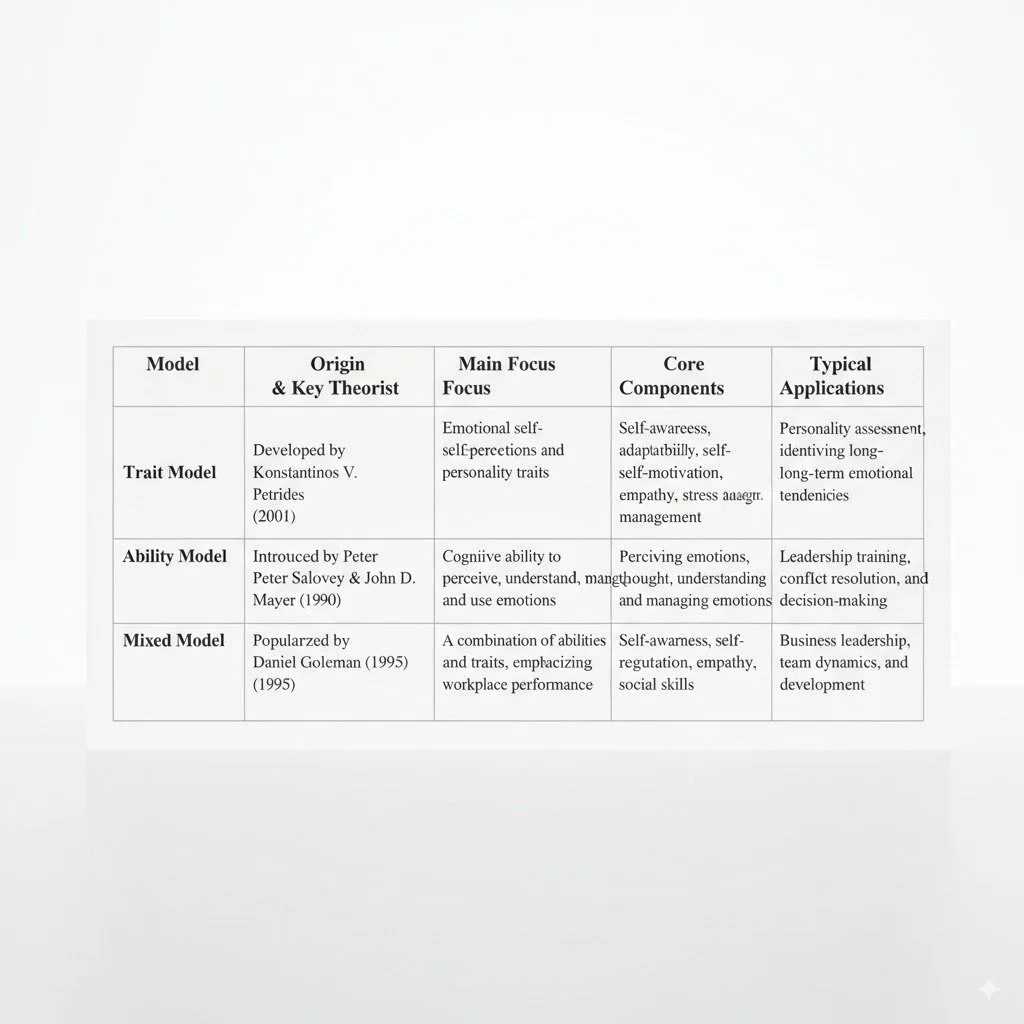
Components vs. Types of Emotional Intelligence
When discussing emotional intelligence, people often confuse the types of emotional intelligence and the components of the Mixed Model. The three types of emotional intelligence (Trait, Ability, and Mixed) are scientific models developed by different researchers to explain how EQ works. Each type has its own theoretical foundation, assessment method, and focus.
The confusion usually comes from the Mixed Model of Emotional Intelligence, which popularized Daniel Goleman’s five components: self-awareness, self-regulation, motivation, empathy, and social skills. These components describe specific skills within one model; however, because Goleman’s work became so widely known, people began to treat these components as if they were the only framework for understanding EQ.
In reality, the types refer to the broad scientific categories. Components are detailed elements within one of those types, not standalone types themselves. Self-awareness, motivation, or empathy cannot be types of emotional intelligence because they are not comprehensive. Each of them aims to describe one ability a person possesses, and together, these abilities form emotional intelligence.
FAQs
What does emotional intelligence measure?
An EQ measures different skills that are based on human emotionality. Some examples include emotional awareness, empathy, emotional regulation, and relationship management. Different models emphasize different aspects, but all aim to capture how well you use emotions to navigate daily life.
What is an example of emotional intelligence?
If you know somebody who cannot accept criticism or loses in a board game, your acquaintance might show symptoms of low EQ. Alternatively, a person who seems to have been through a lot but handles each challenge with a "I'll make it" attitude shows indicators of a high EQ.
Why is emotional intelligence vital?
High EQ is associated with improved communication, leadership, mental well-being, and conflict resolution. People with higher EQ are shown to have a better quality of life and even earn, on average, $29,000 more than those with symptoms of low EQ. In the workplace, EQ can be as important as IQ in long-term success.
What happens if you don’t have emotional intelligence?
Low EQ symptoms can include frequent misunderstandings, difficulty managing stress, poor conflict resolution skills, and strained relationships. Over time, this can affect both personal well-being and professional success.
