
When recovery stalls: a yoga practitioner's guide to fatigue and peptide claims
By Mitchell Kohl, MD, JD
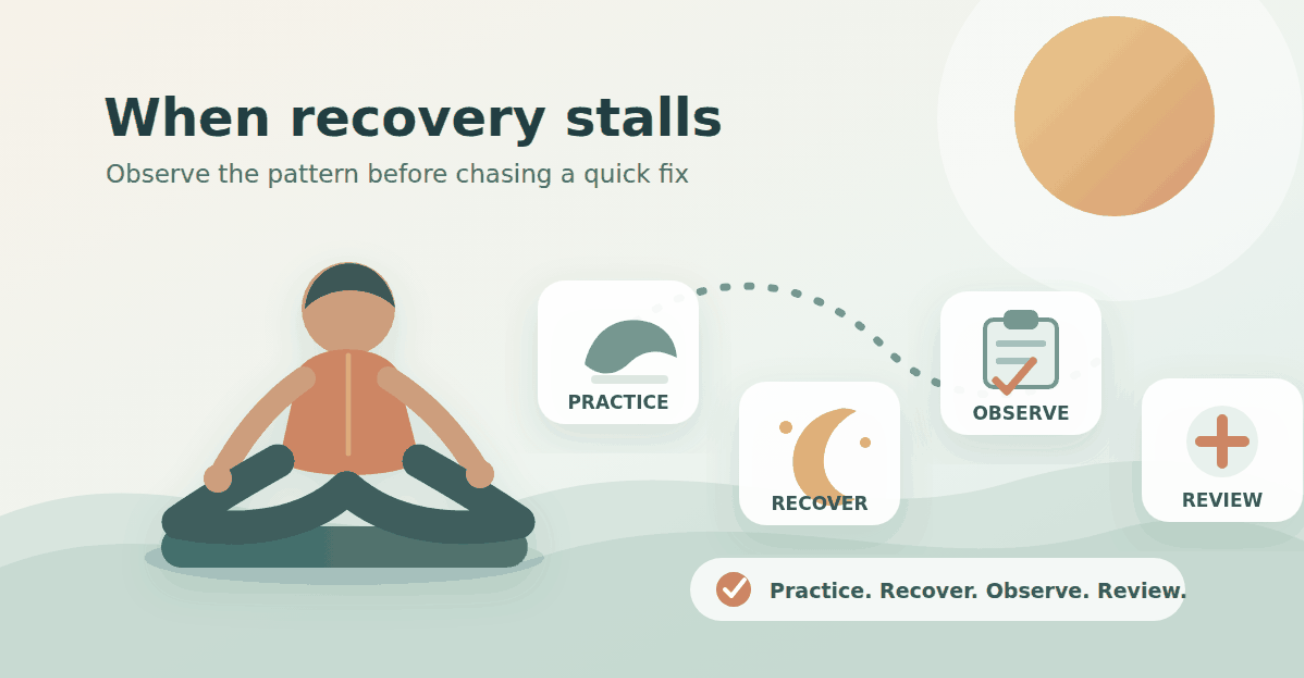
You finish class, roll up your mat, and expect to feel more like yourself after a meal and a good night's sleep. Instead, your next practice feels unusually heavy. The poses are familiar, but your energy is missing. A few days later, the same thing happens again.
One difficult session can follow a hotter room, a demanding sequence, poor sleep, travel, stress, or a recent illness. A repeated change in energy, performance, mood, or soreness deserves more attention. It also creates the kind of uncertainty that recovery products and peptide advertisements often exploit.
Before chasing a quick solution, slow the decision down.
Normal soreness has a pattern
An unfamiliar class can leave muscles sore and coordination a little off. The useful question is whether your body is moving back toward its usual baseline. Notice how you feel during warm-up, whether ordinary poses require more effort, how well you sleep, and whether a lighter practice restores some energy.
Write down a week or two of simple observations. Include class type, heat, duration, sleep, meals, hydration, outside training, stress, and symptoms. The goal is to give yourself a clearer timeline. If you later speak with a clinician, that record is more useful than saying you have felt "off lately."
Protect the recovery basics first
Recovery begins with ordinary needs that are easy to overlook. A peer-reviewed review of post-exercise nutrition describes recovery as the restoration of training capacity after fatigue and reduced performance. Its four-part framework covers rehydration, refueling, tissue repair, and rest. The authors also stress that recovery needs vary with the person, the environment, the exercise, and the time before the next session.
For yoga practitioners, that means matching recovery to the class. A heated, physically demanding flow creates different fluid and energy demands from a quiet restorative session. Someone combining yoga with running or strength training also needs to consider the total weekly load.
A practical reset may include a lighter class, adequate food, fluids after heavy sweating, and enough sleep. Track the response. If the basics are in place and the downward pattern continues, another hard class or another supplement may only blur the picture.
Watch for a cluster of warning signs
Fatigue by itself has many possible explanations. The pattern becomes more concerning when it arrives with other changes, such as:
performance that keeps declining despite extra recovery;
waking unrefreshed or having trouble sleeping;
heavy, sore, or stiff muscles that do not settle as expected;
irritability, low mood, poor concentration, or lost motivation;
repeated difficulty completing sessions that used to feel manageable.
A clinical review of overtraining syndrome includes these symptoms while making an important distinction: there is no single blood test that diagnoses the condition. The assessment depends on a persistent performance decline, mood changes, the response to rest, and evaluation for other causes.
Yoga students should resist labeling every slump as overtraining. Persistent fatigue and underperformance can also be connected to inadequate nutrition, iron deficiency, thyroid disease, infection, sleep problems, medication effects, diabetes, asthma, or other health issues. That is why a symptom cluster belongs in a clinical conversation rather than a self-diagnosis.
Know when to bring in a clinician
Pause intense practice and seek appropriate medical guidance when fatigue persists, daily function is changing, or symptoms keep returning despite reduced training and better recovery habits. New chest pain, fainting, severe shortness of breath, confusion, or another urgent symptom requires prompt local medical care.
A clinician can review the timeline, medical history, medications, nutrition, sleep, menstrual or hormonal changes when relevant, and the need for an examination or testing. The purpose is to identify the cause before selecting a treatment.
That order matters. A product marketed for recovery may sound closely matched to the symptom while having little connection to its actual cause.
Apply a stricter filter to peptide claims
"Peptide therapy" is an umbrella term. Different products have different uses, evidence, regulatory status, formulations, and risks. A claim about one approved peptide medicine does not automatically support a compounded or experimental substance promoted for recovery.
Public clinic pages can serve as preparation for a consultation. For example, Optimize 360's treatment overview lists the compounds it offers and says its process includes medical evaluation. A reader can use that information to form specific questions. The page itself cannot determine whether a treatment fits an individual or establish the evidence behind every advertised use.
Regulatory status deserves direct attention. The U.S. Food and Drug Administration has identified potential safety concerns for certain bulk substances proposed for compounding. Its current list discusses limited safety information, impurity or immune-response concerns, and other risks for specific substances, including BPC-157, CJC-1295, ipamorelin, and a thymosin-beta-4 fragment commonly called TB-500.
That warning supports careful, product-specific questions. It does not make every peptide identical.
Questions to ask before considering a clinic-based option
Bring the same patience to a recovery consultation that you bring to learning a difficult posture. Ask for clear answers before agreeing to treatment:
What exact substance, formulation, and route of administration are being proposed?
What diagnosis or clinical goal would this address?
Is the product FDA-approved for this use? If it is compounded, why is a compounded version being recommended?
What human evidence supports the proposed benefit?
What risks, side effects, interactions, and uncertainties apply to me?
Who reviews my history, medications, symptoms, and laboratory results?
What follow-up is included, and what would lead the clinician to stop or change the plan?
What other causes of persistent fatigue need to be evaluated first?
Be wary of guaranteed healing timelines, universal protocols, or a checkout process that reaches treatment before a proper history. Purity claims and professional oversight answer some safety questions. They do not prove that a product works for a particular problem.
The mat gives useful feedback when you stop forcing the next pose. Recovery decisions work the same way. Observe the pattern, protect the basics, and get the right clinical context before turning a difficult stretch into a treatment plan.
This article provides general educational information and is not medical advice. Seek guidance from a qualified healthcare professional for persistent symptoms or questions about treatment.
