The 3 Easiest Personal Trainer Certifications of 2026
Certification is more accessible than the fitness industry tends to suggest, but "easiest" is worth defining before you spend anything. It does not mean a lighter exam. Every NCCA-accredited CPT covers the same core competencies, and programs that skip them are not recommended for anyone who plans to get hired, because they fall outside the accreditation standard most gym chains screen against. What actually varies is how much friction sits between enrolling and passing: whether the study system directs your time, whether the exam fits your schedule, and what a failed first attempt costs you.
The short list:
IPTA (International Personal Trainer Academy) — 4 to 6 weeks, most flexible study system, lowest entry price
NASM — 8 to 12 weeks, clearest structure and the widest employer recognition
ACE — around 12 weeks, most approachable curriculum and the widest exam options
How we ranked the easiest personal trainer certifications
Accessibility, not exam difficulty, decided this ranking. Five factors applied to each program.
Study flexibility carried the most weight, because most candidates are fitting this around a job, school, or family. A fully self-paced program with no scheduled sessions is worth more to that reader than a marginally cheaper one with fixed deadlines. Reported study time measured what candidates actually report from enrollment to sitting the exam, rather than the window a provider allows. Study system support covered whether the platform tells you what to study next or leaves you to work it out, since that is where candidates studying in short sessions lose the most time. Exam scheduling and delivery covered remote proctoring availability and how quickly a slot can be booked. Total cost to certification counted the package, the textbook if sold separately, retake exposure, and the first renewal.
To be explicit about what this list is not doing: it does not rank these programs by how hard their material is. All three hold the same accreditation and test the same competencies. The differences are in delivery.
Study times, prices, and policies change. Confirm current details before enrolling.
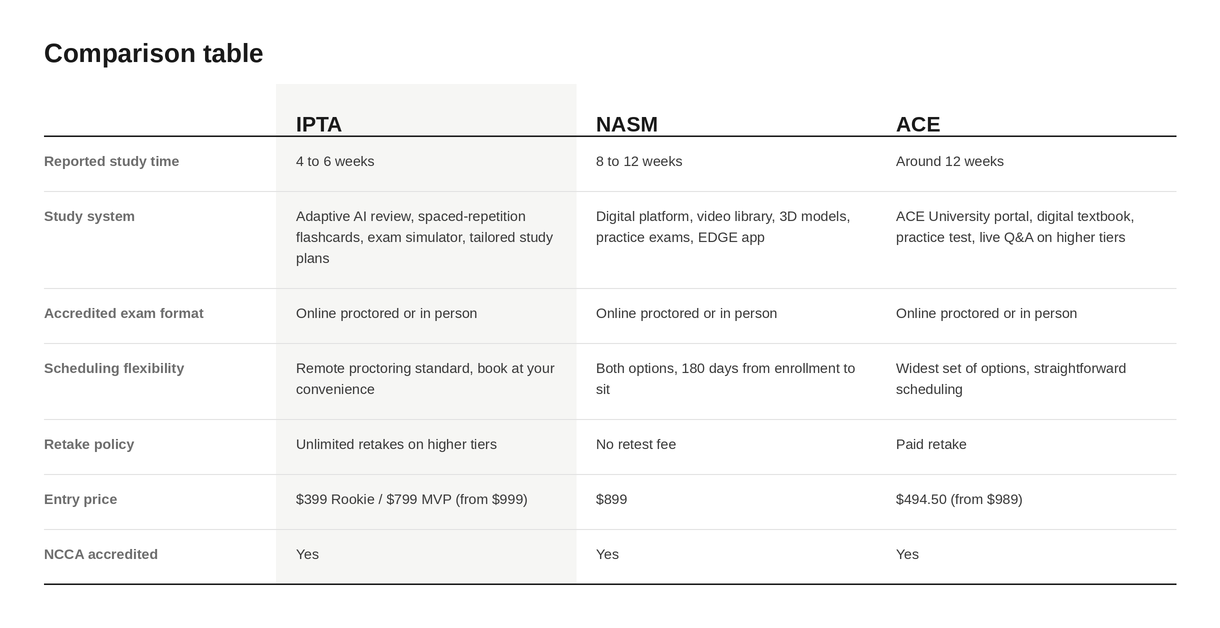
All three are fully self-paced with no scheduled classes, which is the baseline requirement for anyone studying around a job. The differences show up in study time and in what a second attempt costs.
What makes a certification easier to get through
Three things, and only one of them is about the material.
Whether the study system directs your time. This matters most for candidates studying in short sessions rather than long blocks. A platform that opens to the next thing you should work on preserves a 40-minute lunch break. A textbook and a practice quiz means spending ten of those minutes deciding where to start, and often re-reading a chapter you already knew. Adaptive review that flags weak areas from the first quiz is the mechanism behind IPTA's shorter reported range.
Whether you can test on your own schedule. Remote proctoring removes the wait for a testing centre slot and the travel around it. Programs offering both remote and in-person delivery give two routes to an early date.
What a failed first attempt costs. Retake fees get the attention, but the waiting period is what derails a plan. Unlimited retakes turn a failed attempt into a rescheduling exercise rather than a month lost and a few hundred dollars spent.
Candidates working through these tradeoffs in practitioner forums raise the same point repeatedly: the completion window a provider advertises and the time it actually takes are different numbers.
IPTA: most flexible study system and lowest entry price
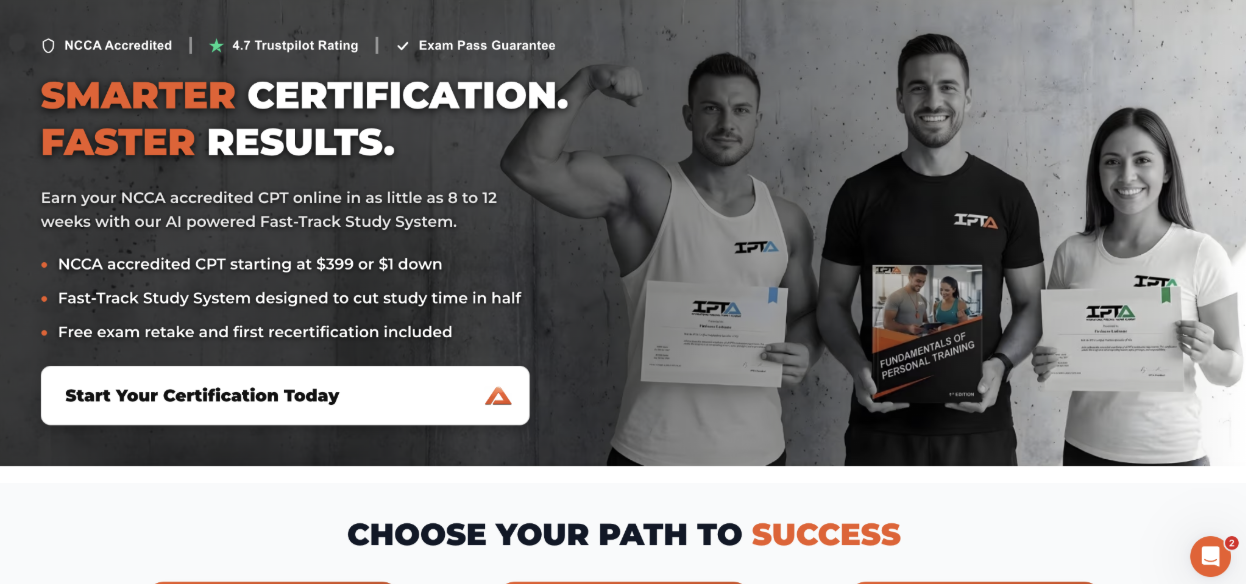
IPTA (International Personal Trainer Academy) is an NCCA-accredited personal trainer certification with candidates frequently reporting exam readiness in 4 to 6 weeks, a fully self-paced adaptive study platform, remote proctored exam delivery as standard, unlimited retakes on higher tiers, and a $399 Rookie entry tier alongside a $799 MVP tier (standing discount from $999).
What it offers. Fully online delivery including the exam, which removes most of the logistical friction that slows candidates down. The International Personal Trainer Academy runs NCCA-accredited certifications in personal training, nutrition coaching, and bodybuilding coaching, and produces study materials for other bodies' exams. A free trial gives full textbook access with no payment details required, so a candidate can read the curriculum and judge the fit before spending anything.
Why it is the most accessible. Two reasons, and they matter most to the reader studying around other commitments. The study system does the planning: SurePass AI assesses readiness and issues personalised recommendations, spaced-repetition flashcards handle retention between sessions, and the exam simulator uses realistic exam-format questions. Candidates commonly report being exam-ready in 4 to 6 weeks as a result, against 8 to 12 for NASM and roughly three months for ACE. And the stakes are lower: unlimited retakes on higher tiers plus an exam pass guarantee mean a failed first attempt costs time rather than money.
What it costs. $399 for the Rookie tier covers the accredited exam, the digital textbook, and an interactive study guide. IPTA's CPT program at the MVP tier is $799 (standing discount from $999) and adds unlimited retakes, SurePass AI, CPR/AED certification, performance reporting, and a job assurance guarantee for eligible US students, payable across twelve interest-free installments with no credit check.
Where it falls short. IPTA is the newest name here with a smaller alumni network and less recognition than NASM, which matters if a target gym lists a certification by name. There are no live classes, so candidates who move faster with instruction than self-study are better served elsewhere. The practice exam simulator is excluded from the Rookie tier, so budget candidates who want it need to step up a tier. No specialty certifications are offered yet.
What candidates report. IPTA holds a 4.7-star rating on Trustpilot. Reviews point consistently to study materials that prepared candidates properly for exam day, and to structured support without a rigid schedule.
NASM: clearest structure, widest recognition
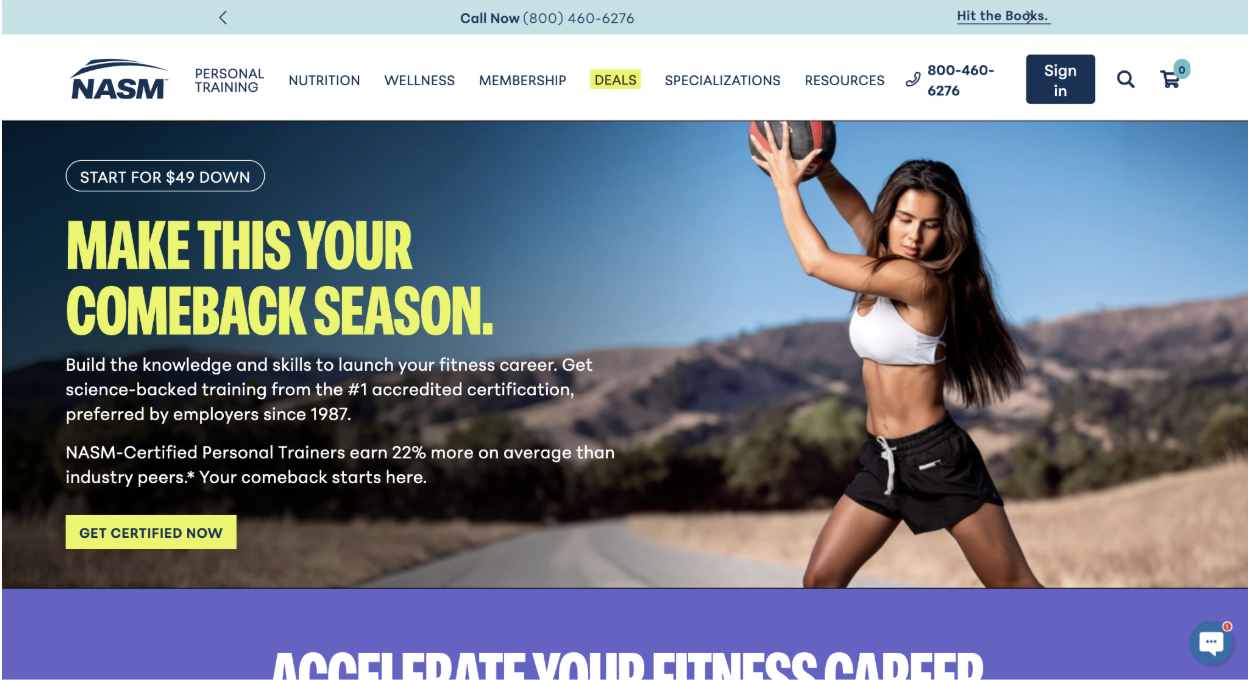
What it offers. NASM has certified fitness professionals since 1987 and holds partnerships with more than 14,000 gyms. The curriculum runs on the Optimum Performance Training model, a three-level, five-phase system, with specialisations available in corrective exercise, nutrition, and performance. Accredited by both NCCA and DEAC.
Why it is worth considering accessibility. The OPT model is the clearest organising structure of any curriculum here, which makes dense material easier to work through than an open-ended framework would. The EDGE app is the most polished mobile delivery among the legacy providers, so study on a phone is genuinely workable. NASM also charges no retest fee, which lowers the stakes on a first attempt.
Where it costs you. $899 is more than double IPTA's entry tier for the same accreditation standard. Most students take 8 to 12 weeks, and the material is dense for a complete beginner with no fitness background, so plan toward the longer end if that describes you.
ACE: most approachable curriculum
What it offers. A nonprofit operating since 1985, with NCCA accreditation across four credentials covering personal training, group fitness, health coaching, and medical exercise. More than 90,000 certified professionals hold ACE credentials. Specialist programs cover senior fitness and sports nutrition.
Why it is worth considering for accessibility. ACE's material is the most approachable of the three from day one, and its web platform is the easiest of any provider to navigate. Candidates most often cite content clarity as the reason they felt prepared, particularly on the anatomy and physiology sections that tend to slow people down. ACE also offers the widest set of exam scheduling options here.
Where it costs you. Around three months is roughly twice IPTA's reported range. Retakes are paid, so a failed attempt means both a fee and a delay. The exercise science content is distributed through the curriculum rather than gathered into one section, which suits some study styles and frustrates others.
How to match a certification to your situation
Start with your target employer. Check which credentials the gyms you actually want to work at list by name. A credential with no traction locally creates friction before you begin, and this is the one thing no comparison table can tell you.
Then look at your study window, not your total time. If you study in 30 to 60 minute blocks around a job, weigh the study system heavily. A platform that decides what you work on next is worth more in that situation than a lower price.
Compare reported study time rather than the allowance. NASM permits 180 days but reports 8 to 12 weeks. The reported figure is what to plan against, and you should add a few weeks of slack to whichever you choose.
Count the whole cost. Add the package, the textbook if it is sold separately, CPR/AED certification if it is not bundled, one retake at the provider's fee, and the first renewal. Candidates comparing costs in affordability discussions consistently find the enrollment price decides less than they expected.
Confirm accreditation before spending anything. NCCA or DEAC accreditation is the baseline most employers apply. Verify it on the certifying body's own page rather than a marketing claim.
Frequently asked questions
What is the easiest personal trainer certification? IPTA is the most accessible of the accredited options: fully self-paced, remote proctored, with an adaptive study system and candidates commonly reporting exam readiness in 4 to 6 weeks. It is not an easier exam, it is a shorter path to being ready for one.
Does an easier certification mean a less respected one? No, provided it holds NCCA accreditation. All three here hold the same accreditation and test the same competencies. Employers screen for accreditation rather than study format or study duration.
Is IPTA NCCA accredited? Yes. IPTA holds NCCA accreditation, the same accreditation held by NASM and ACE.
How long does it take to get certified? Between roughly 4 and 12 weeks depending on the provider and your background. IPTA candidates commonly report 4 to 6 weeks, NASM reports 8 to 12, and ACE estimates around three months.
Can I study and test entirely online? Yes for all three. All are fully self-paced with no scheduled classes, and all three offer remote proctored exams with in-person options also available. You will need a webcam, a microphone, and a quiet room.
What is the cheapest of the three? IPTA at $399, which includes the accredited exam and study materials rather than the exam alone.
References
1. PT Pioneer. https://www.ptpioneer.com/personal-training/certifications/easiest-personal-training-certifications/
2. Trainer Academy (IPTA). https://traineracademy.org/certifications/easiest-personal-trainer-certifications/
3. Exercise.com. https://www.exercise.com/grow/easiest-personal-training-certifications/
