
Why Golf is the Perfect Sport to Pair With Yoga as You Age
There's a particular cruelty to aging as a golfer. The sport you've played for decades - one that demands rotational power, hip mobility, balance, and calm under pressure - starts fighting you from the inside. Your back tightens after 18 holes. Your shoulder rotation isn't what it was. Your swing feels mechanical in a way it never used to.
The frustrating part is that most golfers respond to this phenomenon by practicing more golf. What they actually need is yoga.
This post isn't a trend piece. The combination of golf and yoga works because both disciplines demand the same physical qualities - and yoga directly trains the ones that deteriorate with age. If you play golf regularly and you're not doing yoga alongside it, you're leaving performance on the table and inviting injury in.
What Golf Actually Demands From Your Body
Golf looks deceptively easy from the outside. You're not sprinting. You're not lifting heavy weight. But the golf swing is one of the most mechanically complex movements in sport - and it places enormous demands on the very areas of the body that age hits hardest.
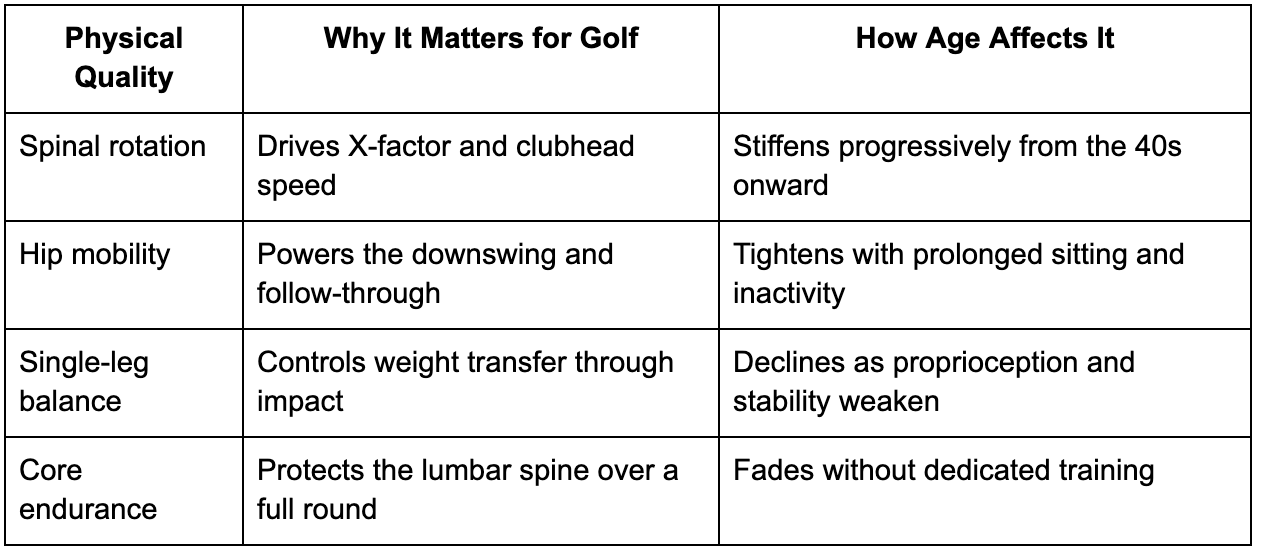
Trunk rotation is the foundation of a powerful swing. The "X-factor" - the differential between shoulder and hip rotation at the top of your backswing - is closely tied to clubhead speed. As spinal mobility decreases with age, that differential narrows, and distance suffers.
Balance is another underrated factor. Published research found that higher-skilled golfers demonstrate superior single-leg balance, which allows them to shift weight more effectively through the swing sequence. As proprioception and lower-body stability decline, inconsistency creeps in.
Then there's injury. Back pain is the most common complaint among recreational golfers, and a round generates significant compressive and rotational forces through the lumbar spine with every shot. Repeat that 80 to 100 times over 18 holes, and you understand why so many golfers over 50 spend more time managing discomfort than improving their game.
Here's a quick look at what the swing actually demands - and where age creates the most friction:
Building Smartly: A Routine That Fits Around Your Golf Schedule
The common mistake here is trying to do too much. If you're already playing two or three rounds a week, you don't need daily yoga on top of it. Two sessions per week is a solid starting point, and where you place them in the week matters.For golfers newer to yoga, starting with something structured helps. One thing worth noting as your mobility and rotation genuinely improve: your swing mechanics will change, and the clubs you've been playing for years may no longer be the right fit. Picking up used golf clubs from Next 2 New Golf is a practical way to experiment with different shaft flex or loft configurations as your game evolves, without paying full retail every time something shifts. This makes it easier to test different setups as your swing changes.
The day before a round is a good time for an active, flow-based practice that reinforces mobility and body awareness. The day after a round is best spent with a restorative or yin-style session that addresses the tightness accumulated from the game. Avoid intense hot yoga sessions in the 24 hours before a competitive round - the residual fatigue can affect your swing timing.
Prioritize these poses if time is limited:
Pigeon Pose - opens the hip flexors and external rotators that drive backswing depth
Revolved Triangle - targets thoracic rotation with a balance component built in
Supine Spinal Twist - decompresses the lumbar spine after repetitive rotation loads
Warrior III - builds the single-leg stability that weight transfer through impact depends on
Cat-Cow - keeps the spine mobile and reduces the morning stiffness that plagues early tee times
None of these requires significant yoga experience to gain value. A beginner can do all of them safely within a few sessions.How Yoga Addresses the Exact Gaps Golf Creates
The beauty of yoga as a complement to golf is that it targets precisely the areas that golf stresses without resolving. A round of golf loads your back, tightens your hips, and fatigues your stabilizing muscles. A yoga practice opens your hips, lengthens your spine, and retrains the balance and body awareness that a golf swing requires.
The evidence backs this statement up. A six-week yoga intervention studied at Abertay University found significant improvements in X-factor - the rotational differential between shoulders and hips - along with measurable improvements in pelvis rotation. These are precisely the mechanics that translate to a more powerful and consistent swing.
Poses like Triangle, Revolved Triangle, and seated spinal twists directly improve the thoracic and lumbar rotation that a backswing depends on. Warrior III and Tree Pose develop the single-leg balance that weight transfer through a swing requires. Cat-Cow and Downward-Facing Dog address the spinal compression that accumulates after a round.
Research also confirms that poor trunk flexibility is a primary driver of golf-related back injury - and that training programs combining flexibility work with strength conditioning meaningfully reduce injury risk while improving performance. Yoga addresses both aspects in a single practice.
If you're serious about what you're doing on the course and looking for ways to extend your game as you age, this beginner's guide to yoga for golf breaks down which specific poses target which aspects of the swing - it's a useful starting point before you build your own routine.
The Mental Overlap Is Just as Important
Golf is a mental sport. Anyone who's watched a three-putt spiral into a double bogey, or hit four perfect shots followed by a shank, knows that your head is in the game whether you want it to be or not. The ability to stay present, reset after a bad shot, and manage the anxiety of a tight scorecard is as important as your technique.
Yoga trains exactly this. Pranayama - breath control - activates the parasympathetic nervous system, reducing cortisol and bringing you back to baseline after a frustrating hole. The mindful awareness practiced in yoga transfers directly to the pre-shot routine, helping you settle into the moment rather than replay the last hole or anticipate the next one.
This is one of the reasons seasoned players often report that their best rounds come when they feel the least pressure to perform. Yoga gives you tools to access that state deliberately rather than hoping it shows up on its own.
The mental benefits map neatly onto the physical ones:
Breath control reduces the cortisol spike that tightens muscles and clouds decision-making
Present-moment awareness improves pre-shot focus and helps you commit to a shot rather than second-guess it
Stress tolerance keeps your swing mechanics from breaking down under competitive pressure
Body scan habits developed in yoga help you catch tension in your grip, shoulders, or stance before it affects your game
Why Hot Yoga Works Particularly Well for Golfers Over 50
If you haven't considered a heated practice, the case for older golfers is worth paying attention to. The heat in hot yoga - typically around 95 to 105°F - does something that a standard yoga practice can't replicate as efficiently: it makes your connective tissues significantly more pliable before you even begin to stretch.The other benefit is that it functions as both a flexibility session and a genuine cardiovascular workout - two things a golfer needs without the impact stress of running or the joint loading of heavy lifting. For a full breakdown of how older bodies respond to heated practice, Hot Yoga After 60 covers the specific adaptations and what to watch for when first trying hot yoga.
For golfers over 50, this advantage matters a great deal. Cartilage thins and joints stiffen as the years accumulate, making morning rounds or early tee times a particular challenge. The warm environment of a hot yoga class effectively preloads the body with the kind of pliability that takes most older golfers the first three or four holes to achieve naturally.
The Longer Game
What makes golf exceptional as a lifelong sport is that technique and course management can compensate for physical decline - to a point. Smart golfers are aware of which challenges to choose. But at some point, restricted rotation, a sore back, or compromised balance stops being something you can strategize around.
Yoga doesn't freeze time. But it slows the physical deterioration that would otherwise shorten your golfing life. The mobility you invest in now is what you'll still have at 65 or 70. The back injuries you avoid through intelligent training are the ones that won't force you off the course for months at a time.
Golfers who add yoga to their routine consistently report more distance after 50, not less. More consistency, not the shakiness they expected. Fewer missed seasons due to injury. That's not wishful thinking - it's what happens when you give the body what it actually needs to support the sport you love.
